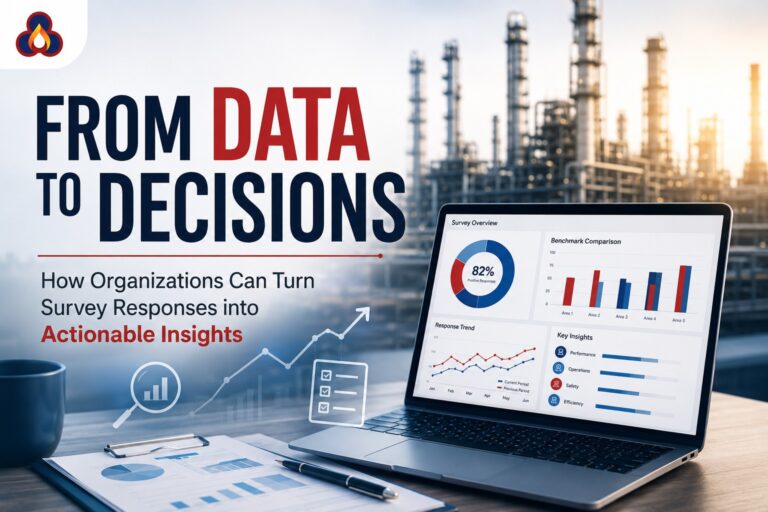
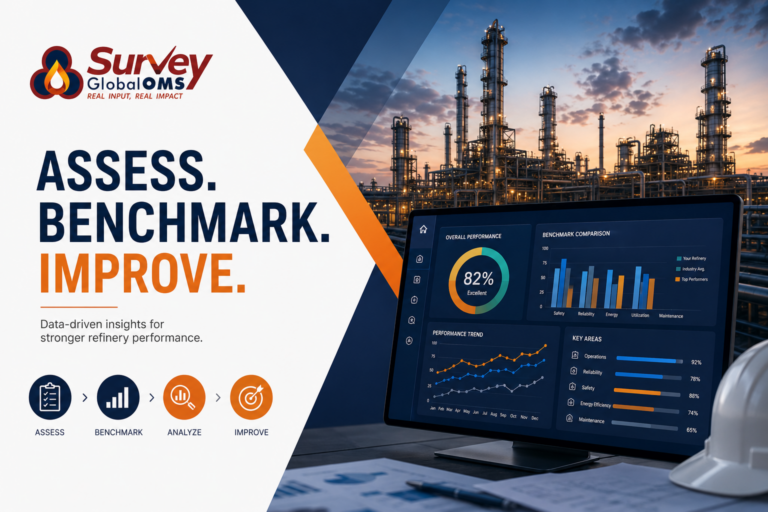
The Future of Industrial Benchmarking: Why Companies Are Moving Toward Insight-Based Survey Platforms and Value-Driven Pricing
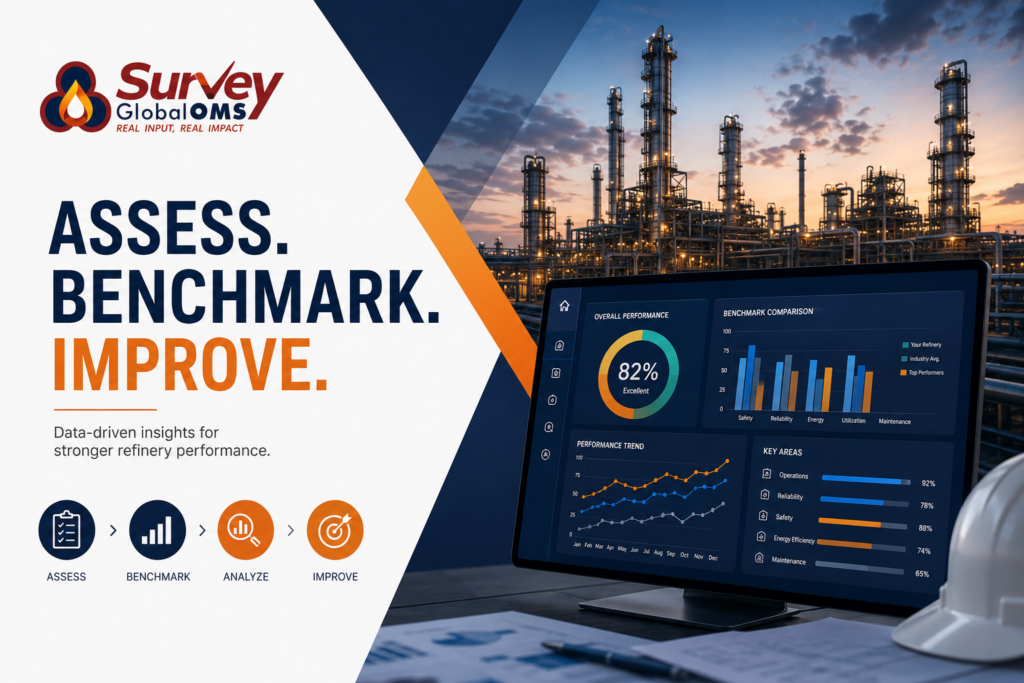
Today’s refineries generate more operational data than ever before.
Advanced automation systems, digital twins, process historians, laboratory systems, and optimization tools continuously collect millions of data points. Yet despite this wealth of information, many organizations still struggle to answer one fundamental question:
How well are we really performing compared to the rest of the industry?
Most refinery leaders know their internal challenges. They understand where blending delays occur, where giveaways continue, and where operational bottlenecks exist. But knowing your own problems is not the same as understanding your competitive position.
And that’s exactly where traditional benchmarking begins to fall short.
Industrial leaders are no longer looking for another report that sits on a shelf after a consultant leaves. They want continuous visibility, measurable performance indicators, and practical insights that guide smarter investment decisions.
That is why industrial benchmarking is undergoing a major transformation. Organizations are moving away from one-time audits and embracing insight-based survey platforms backed by measurable indices, peer comparisons, and value-driven pricing models that evolve alongside their business needs.
Why Traditional Benchmarking No Longer Meets Modern Business Needs
To understand why this shift is happening, it helps to first look at how industrial benchmarking has traditionally worked.
For decades, the process followed a familiar pattern. Consultants visited a refinery, interviewed stakeholders, reviewed documentation, delivered a lengthy report, and considered the engagement complete.
While these assessments often provided useful recommendations, they rarely created an ongoing framework for improvement.
The issue wasn’t the quality of expertise.
The issue was the lack of measurable progression.
Most traditional benchmarking approaches suffer from several common limitations. They are typically conducted only once, making it difficult to measure improvement over time. Many evaluations are influenced by specific technology vendors rather than objective industry standards. Reviews often focus on individual tools instead of overall operational maturity, while meaningful peer comparisons are frequently missing. Most importantly, they fail to provide standardized business indices that allow organizations to quantify maturity, operational effectiveness, and business value.
As a result, many refineries understand their operational problems but still cannot confidently answer how they compare with industry leaders.
The Shift From Data Collection to Actionable Intelligence
Fortunately, industrial benchmarking is beginning to evolve.
Organizations are no longer interested in collecting more information. Instead, they want information that drives decisions.
This represents a significant shift in thinking.
Rather than asking simple questions about installed technology or operational processes, modern assessment platforms focus on understanding the entire business environment.
They evaluate questions such as:
- How mature are current blending operations?
- Which operational areas create the greatest business value?
- How effective is existing automation?
- Where are hidden inefficiencies occurring?
- Which investments will produce the highest return?
In other words, the survey itself is no longer the final deliverable.
The insights generated from the survey become the real product.
This shift enables refinery leaders to move beyond assumptions and begin making decisions backed by structured operational intelligence.
Assessment and Benchmarking Are Not the Same Thing
However, before organizations can unlock meaningful insights, they first need to understand an important distinction.
Assessment and benchmarking are often treated as interchangeable terms.
In reality, they serve two very different purposes.
An assessment establishes your current operational maturity.
Benchmarking measures how that maturity compares with industry standards while identifying financial opportunities for improvement.
The proposal positions these as complementary stages of a broader improvement journey rather than competing services.
Step One: Establishing a Clear Operational Baseline
Every successful improvement initiative begins with understanding the current state.
Without a reliable baseline, organizations cannot accurately measure progress.
This is where a structured Blend Assessment becomes valuable.
Instead of requiring years of historical operating data, the assessment gathers operational intelligence through more than 375 structured questions distributed across 20 operational sections. The process typically takes between 60 and 90 focused minutes, can be completed securely online or through controlled document submission, supports multiple languages, and includes a confidential review discussion under NDA.
More importantly, the assessment transforms operational responses into measurable indicators instead of subjective observations.
That changes the conversation from opinions to evidence.
Turning Survey Responses Into Measurable Business Intelligence
Collecting answers is only the beginning.
The real value lies in transforming those answers into meaningful business metrics.
Modern assessment platforms achieve this through standardized performance indices.
Business Maturity Index (BMI)
The Business Maturity Index evaluates the maturity of refinery blending operations across weighted operational categories.
Instead of relying on a single score, BMI analyzes sections, subcategories, and individual survey responses before comparing them against an ideal reference blending system. This provides a structured picture of operational readiness and highlights improvement priorities.
Value Core Index (VCI)
Operational maturity alone does not tell the complete story.
The Value Core Index identifies the operational areas that contribute most significantly to business performance and highlights where organizations should focus their improvement efforts.
Together, BMI and VCI help refinery leaders understand not only where they are today, but also where attention should be directed first.
When Assessment Evolves Into Benchmarking
While maturity indices provide valuable guidance, executives eventually need answers to a much bigger question.
What is the financial impact of these operational gaps?
This is where benchmarking begins.
Unlike an assessment, benchmarking incorporates infrastructure reviews, automation evaluations, optimization studies, and three to five years of historical operating data. These projects typically span five to six months, allowing organizations to measure operational performance against both peer refineries and industry best practices.
Instead of identifying where gaps exist, benchmarking begins calculating what those gaps are actually costing the business.
That shift transforms operational analysis into strategic decision-making.
Measuring Operational Performance That Actually Matters
Benchmarking introduces another important advancement.
Rather than relying solely on maturity scores, organizations begin measuring operational effectiveness itself.
Automation Effectiveness Index
Simply investing in automation does not guarantee better business outcomes.
The Automation Effectiveness Index evaluates refinery infrastructure across multiple blending subsystems and measures how effectively automation supports operational performance compared with industry expectations.
Operational Efficiency Index
Operational Efficiency focuses on historical refinery performance to estimate unrealized business value.
Using historical operational data and optimization analysis, this index identifies lost blending opportunities while estimating potential improvements and expected return on investment.
Together, these indices help organizations prioritize investments based on measurable business impact rather than intuition.
Why Peer Benchmarking Is Becoming Essential
Even excellent internal performance tells only part of the story.
The real competitive advantage comes from understanding how your refinery performs compared to similar operations.
Modern benchmarking platforms make this possible through anonymized peer comparison dashboards.
Rather than simply presenting internal scores, organizations can compare their BMI, VCI, Automation Effectiveness, and Operational Efficiency against participating refineries while protecting the identity of every participant.
These percentile-based comparisons allow organizations to determine whether they are performing near the industry median, approaching upper-quartile performance, or competing alongside best-in-class operators.
This external perspective often provides the confidence executives need when prioritizing capital projects and operational improvements.
Why Value-Driven Pricing Is Replacing Traditional Consulting Models
As industrial benchmarking has evolved, so has the way organizations purchase these services.
Historically, companies paid for consulting hours.
Today, they increasingly pay for measurable outcomes.
The proposed roadmap reflects this changing mindset.
Organizations can begin with a complimentary maturity assessment before progressing toward personalized dashboards, comparative industry insights, comprehensive benchmarking studies, and advanced peer comparison platforms. Each stage delivers progressively deeper operational intelligence, allowing organizations to invest according to the level of business value they require rather than committing to a single large consulting engagement upfront.
This staged approach makes advanced benchmarking more accessible while ensuring every investment produces tangible insights.
Benchmarking Is Becoming a Continuous Improvement Journey
Perhaps the biggest difference between traditional benchmarking and modern survey platforms is their purpose.
One delivers a report.
The other creates an ongoing improvement ecosystem.
Rather than stopping after an assessment, organizations can continue progressing through increasingly advanced levels of operational intelligence.
The roadmap begins with an online maturity assessment, advances into BMI and VCI dashboards, expands into anonymous peer benchmarking, and ultimately evolves into full refinery benchmarking supported by Automation Effectiveness and Operational Efficiency dashboards.
Instead of measuring performance once every few years, organizations gain a framework that supports continuous monitoring, structured improvement, and smarter investment planning.
The Future of Industrial Benchmarking Is Built on Insight
Ultimately, every trend in industrial benchmarking points toward one common goal.
Better decisions.
Industrial companies already possess enormous volumes of operational data.
What they increasingly need is context.
Context explains whether current performance is competitive.
Context identifies hidden business value.
Context reveals where investments will generate the highest return.
Context transforms operational data into strategic direction.
That is why the future of industrial benchmarking is moving beyond spreadsheets, isolated audits, and static reports. It is becoming an ecosystem of structured assessments, standardized performance indices, interactive dashboards, peer benchmarking, and continuous operational intelligence.
Organizations that embrace this evolution will not simply collect more data.
They will understand it better.
They will improve faster.
And in an industry where even small improvements can translate into millions of dollars in operational value, that competitive advantage may become the most valuable benchmark of all.
About the Author