Best Industrial Assessment Platform for Refineries: How to Measure & Benchmark Performance (2026)
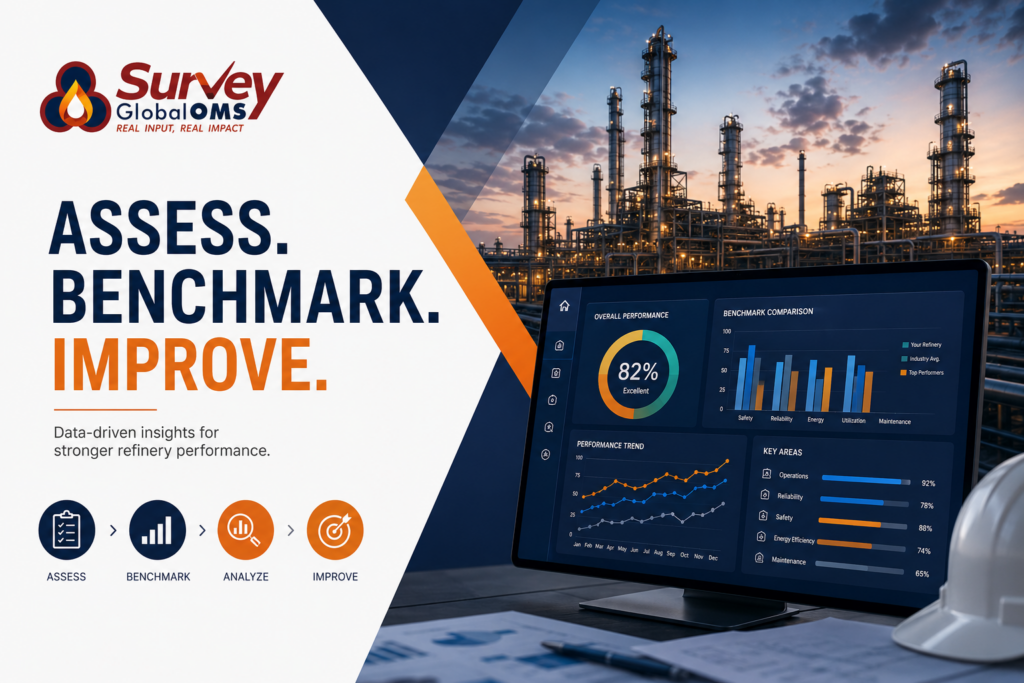
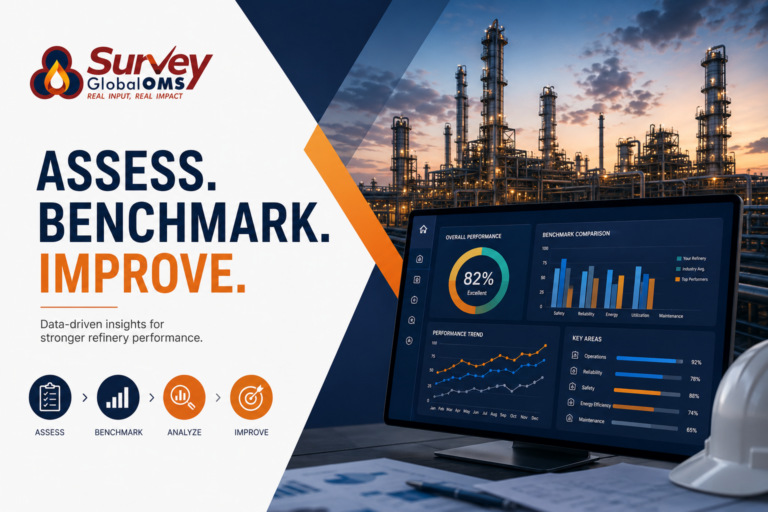
Refineries today need a clear, data-driven way to measure performance and stay competitive. Traditional methods fall short in identifying real inefficiencies and comparing results across the industry.
Industrial assessment platforms solve this by providing structured evaluation, measurable insights, and benchmarking against industry standards, enabling smarter operational decisions.
What Is an Industrial Assessment Platform in Refineries?
An industrial assessment platform is a structured system that evaluates refinery operations using standardized surveys and metrics. It converts inputs into clear insights on performance, efficiency, and gaps.
In refineries, it helps measure key areas such as blending, automation, and governance, and aligns results with industry benchmarks. This enables data-backed decisions and targeted improvements.
Why Traditional Refinery Performance Evaluation Methods Fail
Traditional refinery performance evaluation relies on spreadsheets, isolated KPIs, and internal reports, which provide limited and fragmented insights.
This makes it difficult to detect operational inefficiencies in refineries, such as over-blending, poor system integration, and hidden value losses. Data lacks standardization and context, leading to incomplete analysis.
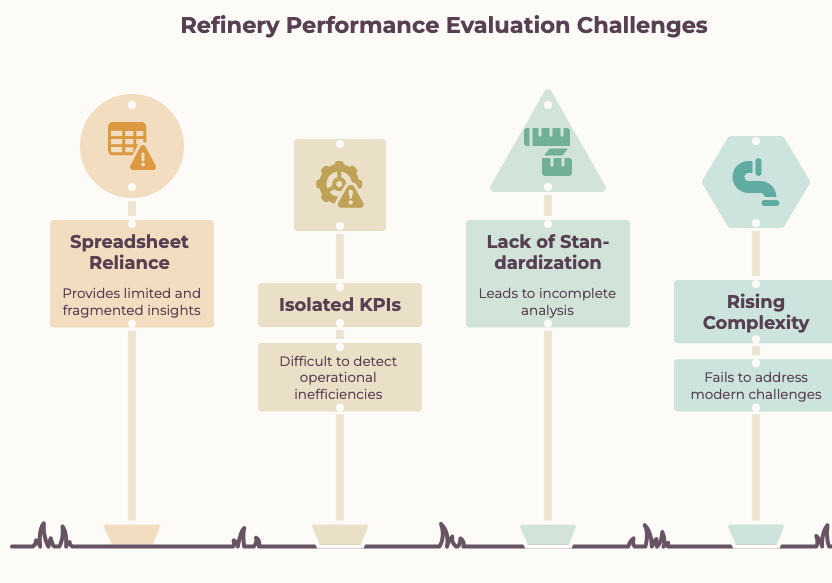
With rising complexity and stricter demands, these outdated approaches fail to address modern refinery performance challenges, leaving organizations without clear, benchmarked, and actionable insights.
How to Assess Refinery Performance Using a Structured Assessment Survey
To effectively assess refinery performance, a structured approach is essential. A refinery assessment survey breaks down operations into key areas such as blending, automation, and governance, providing a comprehensive view of performance.
A focused blending system assessment further evaluates how efficiently blending processes are planned and executed, helping to identify gaps such as giveaway losses or poor coordination.
This structured method ensures standardized evaluation, clearer insights, and a reliable foundation for performance improvement.
What Is Refinery Benchmarking and Why It Matters
Refinery benchmarking is the process of comparing a refinery’s performance against industry standards and peer operations to understand its relative position.
Using industrial benchmarking tools, refineries can evaluate key metrics, identify performance gaps, and measure how effectively their operations align with best practices. This goes beyond internal analysis by adding external context.
Benchmarking refinery performance is critical because it helps organizations identify competitive strengths, uncover inefficiencies, and make informed, data-driven decisions for improvement.
Key Metrics Used in Refinery Assessment (BMI, VCI Explained)
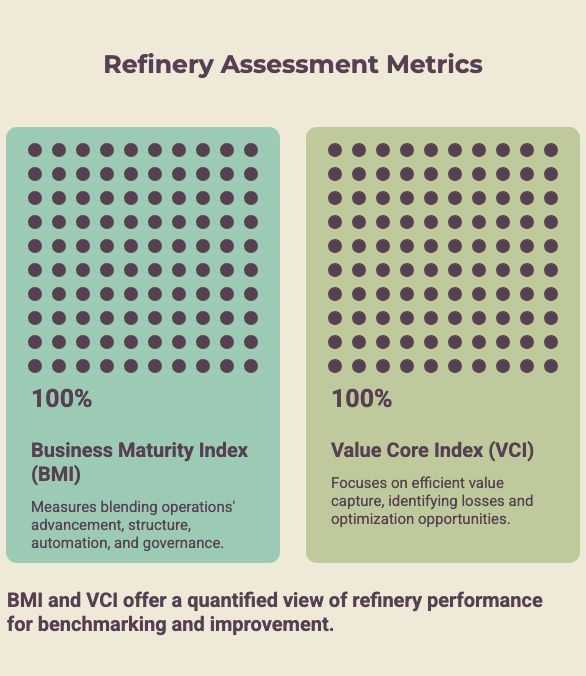
In modern refinery evaluation, refinery performance metrics are essential for turning complex operations into measurable insights. Two key metrics widely used are the Business Maturity Index (BMI) and the Value Core Index (VCI).
The Business Maturity Index (BMI) measures how advanced and structured a refinery’s blending operations are, including planning, execution, automation, and governance. It reflects overall operational maturity.
The Value Core Index (VCI) focuses on how efficiently a refinery captures value from its operations, identifying losses, inefficiencies, and optimization opportunities.
Together, BMI and VCI provide a clear, quantified view of performance, enabling better benchmarking and targeted improvement.
Best Industrial Assessment Platform for Refineries (Features to Look For)
Selecting the best industrial assessment platform is essential for accurate evaluation and real business impact. The platform should offer secure surveys to ensure sensitive refinery data is protected while collecting structured, reliable inputs.
Strong benchmarking dashboards are equally important, as they convert assessment data into clear performance insights and industry comparisons. This allows teams to move beyond internal analysis and understand their true position.
Additionally, features like expert review help interpret results and guide next steps, while NDA protection ensures confidentiality and encourages honest participation.
Platforms like Survey GlobalOMS bring these capabilities together by combining secure, expert-led assessments with benchmarking insights, making it easier for refineries to measure, compare, and improve performance effectively.
Benefits of Using Refinery Benchmarking Tools for Operational Efficiency
Modern refinery benchmarking tools provide a clear, data-driven view of operations, helping identify inefficiencies that are often missed in traditional evaluations. They highlight gaps in blending, automation, and coordination, enabling targeted improvements.
By aligning performance with industry standards, these tools enhance operational efficiency, reduce value losses, and support smarter decision-making. The result is better resource utilization, improved margins, and more consistent operational performance.
How Survey GlobalOMS Helps in Refinery Assessment and Benchmarking
As a specialized refinery assessment platform, Survey GlobalOMS enables organizations to move from basic evaluation to structured, insight-driven improvement.
It delivers structured insights through well-designed surveys that capture real operational conditions, while its benchmarking dashboards provide clear visibility into performance and industry positioning. Additionally, expert-led surveys ensure that results are not just data points but actionable guidance.
This combination allows refineries to assess accurately, benchmark effectively, and implement improvements with confidence.
How to Choose the Right Refinery Assessment Platform (Checklist)
| Checklist Criteria | What to Look For in a Refinery Assessment Platform | Why It Matters for Performance & Benchmarking |
| Does it provide refinery benchmarking? | Look for platforms with built-in refinery benchmarking tools and peer comparison dashboards | Helps you understand your position vs industry standards and competitors |
| Does it use standardized indices (BMI, VCI)? | Ensure the platform uses refinery performance metrics like Blending Maturity Index (BMI) and Value Core Index (VCI) | Converts complex operations into measurable insights for better decision-making |
| Is data confidential and secure? | Check for NDA protection, domain-level access, and secure data handling systems | Ensures sensitive refinery data is protected and encourages honest participation |
| Does it offer expert review and guidance? | Platforms should include expert-led assessment reviews and interpretation support | Transforms raw data into actionable strategies and improvement plans |
Quick Tip: The best industrial assessment platforms combine benchmarking, standardized metrics, security, and expert insights to deliver both clarity and action.
Frequently Asked Questions About Refinery Assessment and Benchmarking
What is the best way to assess refinery performance?
The best way is through a structured refinery assessment survey using standardized metrics and benchmarking tools. It evaluates key areas like blending and operations, helping identify inefficiencies and providing a clear, data-driven performance view.
What is refinery benchmarking?
Refinery benchmarking is the comparison of a refinery’s performance against industry standards and peers to identify gaps and improvement opportunities.
What are refinery performance metrics?
These are standardized measures used to evaluate operations, such as Blending Maturity Index (BMI) for maturity and Value Core Index (VCI) for efficiency and value capture.
How do industrial assessment platforms work?
They collect survey data, analyze it using structured frameworks, generate performance insights, benchmark results, and provide actionable recommendations.
Are refinery benchmarking tools confidential?
Yes, we use NDA protection, secure systems, and controlled access to ensure data confidentiality.
How long does a refinery assessment survey take?
Typically 30 to 60 minutes, depending on the survey scope.
Conclusion: Why Industrial Assessment Platforms Are the Future of Refinery Optimization
Modern refinery optimization requires more than internal analysis; it demands a structured, data-driven evaluation. Industrial assessment platforms provide this by combining standardized surveys, performance metrics, and benchmarking into one clear framework.
They enable refineries to measure accurately, identify inefficiencies, and act with confidence. As complexity grows, these platforms are becoming essential for achieving consistent, scalable, and competitive operational performance.
About the Author